The Yes / No / Maybe List: A Calm Way to Talk About What You Both Want
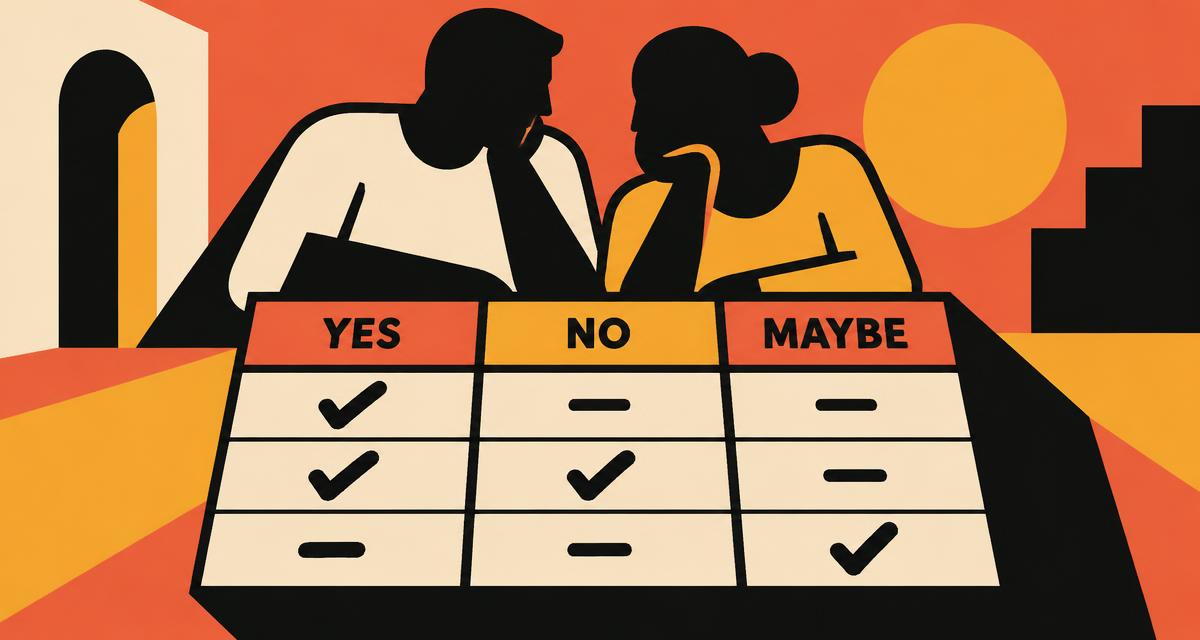
A yes/no/maybe list is a written checklist of intimate activities that each partner marks separately as yes (I want this), no (hard limit), or maybe (curious, needs conditions). You compare the two sheets afterwards and only the overlapping "yes" answers become part of your life together. That's the whole method — and it works because nobody has to say the awkward sentence out loud first.
It is the single most useful conversation tool for couples who love each other but have never managed to have one honest talk about sex. If you've ever thought "I'd try that, but I don't know how to bring it up", this list is the bring-it-up.
In this guide: how the list works, a complete ready-to-use checklist across five sections, how to read your results, what to do with the "maybe" column, and how to keep the conversation safe.
Try a few questions right now
Free · No sign-up
Why a written list beats a conversation
Talking about sex live is hard for a specific reason: you're asking and being judged at the same moment. You watch your partner's face while you say the thing, and one flicker of surprise is enough to make you take it back.
A written list removes that. Three things change:
- You answer privately. No reaction to read, no tone to manage.
- You answer everything. Including items you'd never raise, because the list raises them for you.
- A "no" is a checkbox, not a rejection. It reads as information instead of disappointment.
Couples therapists have used versions of this checklist for decades, mostly because it separates discovering what someone wants from negotiating it. Those are two different conversations and they go badly when they happen at once.
How to do it in six steps
- Each of you gets your own copy. Same list, filled in alone. No peeking, no discussing mid-way.
- Answer for what you actually want, not what you think you should want, and not what you assume your partner wants to hear.
- Use all three marks. Y = yes, want it. N = no, not for me. M = maybe, under the right conditions.
- Add one line to every M: what would have to be true for it to become a yes.
- Compare together, in a neutral place. Kitchen table, clothes on, not in bed, not after an argument.
- Read only the overlaps out loud first. Start with what you both said yes to. That's the part that makes the whole exercise feel good instead of exposing.
Set a rule before you start: nothing on this list happens tonight. The list is for information. Removing the pressure to act is what makes people answer honestly.
The list
Copy it, screenshot it, or write the letters on paper. Five sections, from mild to bold.
1. Talking and anticipation
| Item | Y / N / M |
|---|---|
| Saying out loud what I like during sex | |
| Being asked what I want, mid-moment | |
| Talking about a fantasy without acting on it | |
| Flirty texts during the day | |
| Voice messages | |
| Photos (sent, not stored) | |
| Being told in the morning what's planned for the evening | |
| Reading something explicit together | |
| Watching something together | |
| Debriefing afterwards — what worked, what didn't |
2. Touch, pace and setting
| Item | Y / N / M |
|---|---|
| Long build-up, nothing rushed | |
| Fast and spontaneous, no build-up | |
| Massage with no expectation of more | |
| Showering or bathing together | |
| Full lights on | |
| Complete dark | |
| Music on | |
| Being watched — mirror, phone camera, nothing saved | |
| A different room in the house | |
| Somewhere away from home (hotel, trip) |
3. Dynamics and roles
| Item | Y / N / M |
|---|---|
| Being clearly in charge | |
| Clearly handing over control | |
| Taking turns leading, same evening | |
| Being told what to do | |
| Telling my partner what to do | |
| Playful resistance | |
| Being teased and made to wait | |
| Making my partner wait | |
| Praise out loud | |
| Rougher than usual — within agreed limits | |
| A rule we keep for a whole day |
4. Toys, props and variety
| Item | Y / N / M |
|---|---|
| A toy used on me | |
| A toy I use on my partner | |
| Buying something together, in person or online | |
| Blindfold | |
| Restraints (soft) | |
| Ice, warmth, texture | |
| Clothing chosen by my partner | |
| Costumes or a character | |
| Scripted scenario we agree on in advance | |
| Something we invent on the spot |
5. Frequency, boundaries and aftercare
| Item | Y / N / M |
|---|---|
| More often than now | |
| Scheduled — an evening in the calendar | |
| Sex with no expectation of finishing | |
| Solo, with my partner present | |
| Solo, separately, and telling each other | |
| A safe word we both know | |
| Stopping at any point, no explanation needed | |
| Being held for a while afterwards | |
| Being left alone afterwards | |
| Talking the next day about what happened |
Anything missing that matters to you? Add rows. A list you extended yourself is a better list.
How to read your results
Lay the two sheets side by side and sort every row into one of four buckets.
| Both marked | What it means | What to do |
|---|---|---|
| Y + Y | Shared want, currently unused | Pick one. Do it this month. |
| Y + M | One wants it, one is curious | Ask what would turn the M into a Y. Conditions, not persuasion. |
| M + M | Neither of you would have raised it | The most interesting bucket. Try the smallest version of it. |
| Anything + N | Closed | Closed. No negotiating, no "but why not". |
The Y+Y bucket is usually bigger than both partners expected. That's the normal outcome, and it's the point: most couples aren't mismatched, they're just unspoken.
The "maybe" column is the whole game
A "maybe" almost never means I'm undecided. Decoded, it usually means one of five things:
- "Yes, with you specifically, not in general."
- "Yes, if I can stop halfway without it being a big deal."
- "Yes, but not the version I've seen online — a gentler one."
- "Yes, if we agree on it beforehand instead of it just happening."
- "Yes, if you're clearly into it too and not just doing it for me."
So write the condition next to every M. M — only away from home. M — only if we agree on a word to stop. M — once, and then we talk about it. A maybe with a condition attached is actionable. A bare maybe just sits there.
Hard limits, and why the no column matters most
The list only works if a no is genuinely untouchable. Not "no for now, let's see", not "no but I'll wear you down". No means the item is off the table and never comes up again as leverage.
That guarantee is what buys you the honest answers everywhere else. Partners who trust their no's answer their maybe's truthfully. Partners who don't, mark everything N and the exercise tells you nothing.
Two more rules worth writing down:
- A safe word beats a safe sentence. One agreed word that means stop immediately, no discussion, no analysis until later.
- A yes is revocable mid-way. Consenting to something on a checklist last Tuesday is not consent tonight.
When to redo the list
Every 6 to 12 months, and after anything big — a move, a baby, a health change, a long dry spell, a repair after a rough patch. People's answers move more than they expect. Items that were a firm N two years ago show up as M, and some old Y's quietly turn into "actually, not anymore".
Keep the old sheets. Comparing them is its own conversation, and usually a good one.
If you'd rather be asked than fill in a form
Some couples freeze in front of a blank checklist. The prompt-by-prompt version is easier: one question at a time, answer, next card, no form staring back at you.
That's what the Couples Heat deck in Here We Ask does — intimate questions dealt one at a time, with intensity levels so you can start mild and go further only if you both want to. Free, in the browser, nothing to install.
Related reading:
- Sexual Compatibility Questions for Couples — the conversation version of this list
- Kink Test Questions for Couples — if the dynamics section was your favourite part
- Sex Questions Couples Are Afraid to Ask — the questions underneath the checkboxes
FAQ
What is a yes/no/maybe list? A written checklist of intimate activities that each partner marks privately as yes, no, or maybe. You compare afterwards and act only on the shared yes answers.
Is it the same as a kink checklist? A kink checklist is one section of it. A yes/no/maybe list covers everything from flirty texts and pacing to dynamics and toys, so it works for couples with no interest in kink at all.
Do we have to fill it in separately? Yes. Filling it in together defeats the purpose — you end up answering for the person sitting next to you instead of for yourself.
What if our lists barely overlap? Look at the maybe column before you conclude anything. Most "we want different things" results turn out to be "we want the same things under different conditions". If a genuine mismatch remains on something central, that's a conversation worth having with a therapist, not a reason to force it.
What if my partner refuses to do it? Don't push. Ask what specifically feels bad about it — usually it's fear of being judged for an answer, or fear of being held to one. Both are solvable: agree that nothing on the list gets acted on without a second conversation.
How long does it take? Fifteen minutes each to fill in, thirty to compare. Don't do both in the same hour — leave a day in between so nobody feels rushed into their own answers.
Can we use it in a new relationship? Yes, and it's arguably more useful early. Just cut the last section down and treat every M as "later", not "this week".