Sexual Compatibility: What It Actually Means and 45 Questions to Test Yours
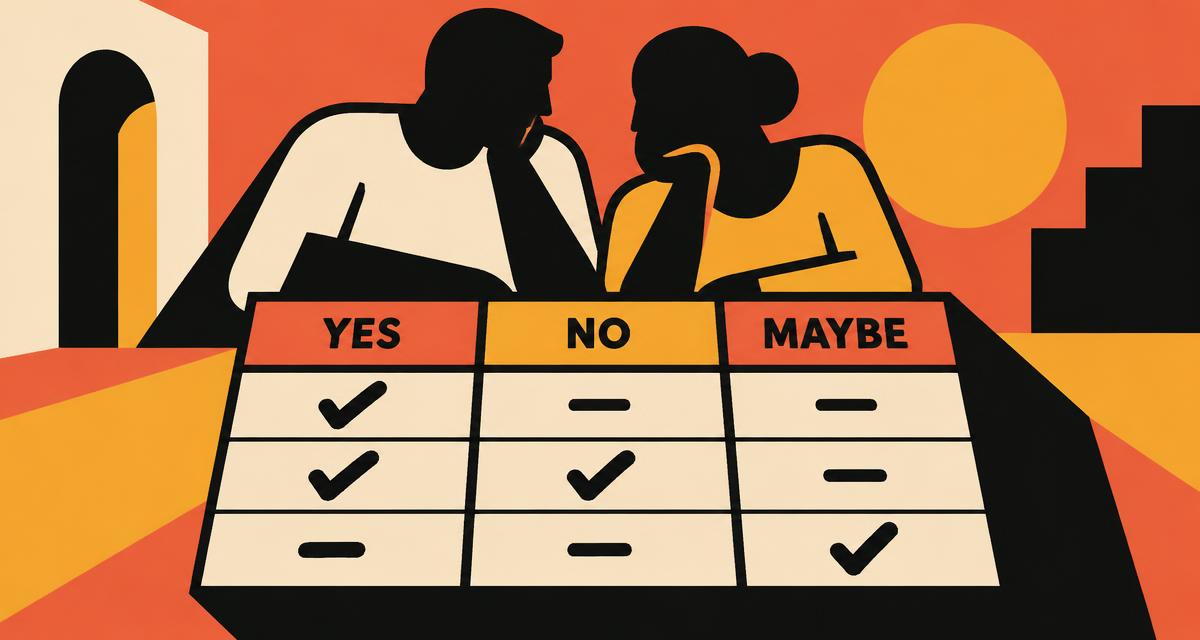
Sexual compatibility is mostly a communication outcome, not a fixed trait. Here is how to map yours with 45 honest questions.
Sexual compatibility is one of the most misunderstood ideas in modern relationships. Most people treat it like a fixed trait — you either have it or you don't, like matching blood types.
That's wrong, and the misunderstanding ends relationships that didn't need to end.
Sexual compatibility is mostly a communication outcome. Two people with very different default preferences can be highly compatible if they talk well. Two people with nearly identical preferences can be miserable if they never say them out loud.
Here's how to figure out where you actually stand — and 45 questions to get you there.
Try a few questions right now
Free · No sign-up
What sexual compatibility actually measures
It's not "do we like the same things." It's the overlap of four separate dimensions, and couples usually mismatch on only one:
Desire frequency. How often each of you wants intimacy, and how much variance you tolerate. This is the mismatch people notice first and misdiagnose most often.
Desire type. Spontaneous versus responsive desire. Spontaneous desire arrives on its own; responsive desire shows up after physical or emotional context is created. Research by Emily Nagoski popularized this distinction, and it explains a huge share of "we're not compatible" conclusions. A responsive-desire partner isn't uninterested — they're waiting for a runway that never gets built.
Style and preference. What each of you actually enjoys — pace, intensity, novelty, routine.
Communication comfort. How easily each of you can name a want, a limit, or a disappointment without it becoming a fight.
The fourth one predicts satisfaction better than the first three. A couple with a frequency gap and excellent communication usually does fine. A couple with matched frequency and zero communication usually doesn't.
The 45 questions
Read them together, out loud. Answer both. Don't grade each other.
Baseline (1–10)
- How often would you want sex in an ideal week — not the polite answer?
- What's the longest gap that feels okay to you before it starts to matter?
- Do you usually want it before you're aroused, or does the wanting show up after things start?
- What time of day are you actually most interested?
- What normally puts you in the mood — physically, emotionally, environmentally?
- What reliably shuts it down?
- How do you prefer to initiate?
- How do you like being turned down when the answer is no?
- What does "good sex" mean to you in one sentence?
- Are we having the amount of sex you want right now? Honestly.
Preference mapping (11–25)
- What's something we do that you'd want more of?
- What's something we do that you'd quietly drop?
- Do you prefer familiar and reliable, or new and uncertain?
- How important is foreplay to you, and what counts as foreplay?
- What's your preferred pace — slow build or straight in?
- How do you feel about talking during sex?
- What's something you like that you've never asked for?
- How do you feel about planned versus spontaneous?
- What role does the setting play for you — light, sound, location?
- What kind of touch do you want more of outside of sex?
- What's a hard limit you want me to know?
- What's a soft limit — something you'd only try in the right context?
- How do you feel about toys, and has that changed?
- What's the role of humor for you here — welcome or ruinous?
- What would an ideal night look like from start to finish?
The uncomfortable ones (26–35)
- Have you ever pretended to want it when you didn't? What would you have preferred to say?
- Is there anything about our sex life you've been avoiding telling me?
- Have you ever felt pressured by me? When?
- Have you ever felt rejected by me in a way that stayed with you?
- What's a fantasy you've had that you assume I'd react badly to?
- Do you watch porn, and does it shape what you want?
- Is there anything about your own body that gets in the way?
- Have past experiences affected what feels safe for you?
- What's the most vulnerable thing you could tell me right now?
- What do you think I want that you're not sure you can give?
Repair and direction (36–45)
- When was our best period, and what was different then?
- What changed for you in the last year?
- How do we get back on track after a dry spell without blaming each other?
- What's a signal we could use that means "I'm interested, no pressure"?
- How should we handle it when one of us wants it and the other doesn't?
- What could I do outside the bedroom that would make a difference inside it?
- What's one experiment you'd be willing to run this month?
- How often should we talk about this — and can we schedule it?
- What would make this conversation easier next time?
- What do you want me to remember from tonight?
Reading your answers
Frequency gap, similar preferences. Very common, very fixable. Build a low-pressure initiation signal (question 39) and address the responsive-desire runway. The lower-desire partner is not broken.
Matched frequency, mismatched style. The easiest kind. It's a negotiation, not an incompatibility. Alternate whose preference leads.
Big gap on the uncomfortable section. If one of you answered questions 26–35 with real content and the other deflected everything, the problem isn't sex. It's disclosure safety, and that's the thing to work on first.
Genuine hard-limit conflict. If one person's essential need is another's hard limit, that's real incompatibility. It's rare, and it deserves an honest conversation rather than years of resentment.
FAQ
Can sexual compatibility be improved, or is it fixed? Mostly improved. Frequency, style, and communication all move with effort. Only genuine hard-limit conflicts are structurally fixed.
How important is sexual compatibility to a relationship's survival? Studies of long-term couples consistently find sexual satisfaction matters, but perceived responsiveness — feeling that your partner hears and cares about your needs — predicts satisfaction more strongly than frequency does.
We have different sex drives. Are we doomed? No. Desire discrepancy is the single most common complaint couples bring to therapy, and it's one of the most treatable. The damage comes from the story each partner tells about it, not the gap itself.
When should we have this conversation? Not immediately after sex, not during a fight, not at midnight. A neutral, clothed, unhurried moment works best.
Should new couples talk about this early? Yes — a light version of questions 1–10 in the first months prevents years of guessing.
Have the conversation without starting it
The hardest part of this conversation is question zero: who brings it up, and how.
Here We Ask hands that job to a deck. You draw, you answer, and neither of you had to be the person who "wanted to talk about it." The couples decks scale from warm and playful to the questions above.
Free to play, no account needed.