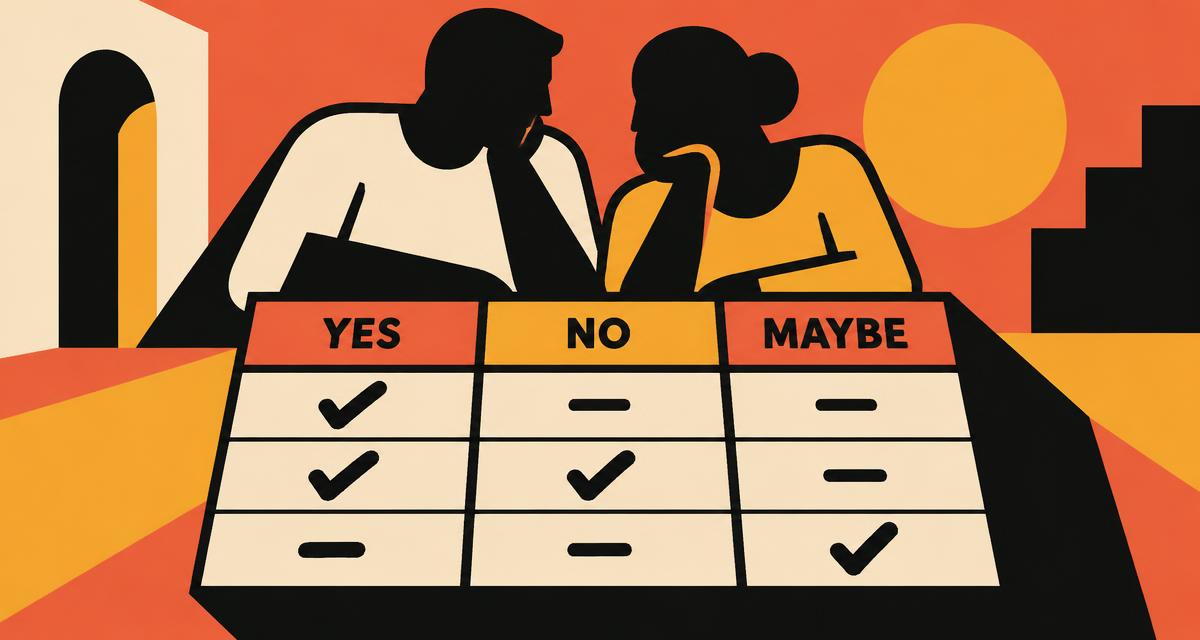
The Boundaries Checklist: 25 Boundaries Every Healthy Relationship Needs
Setting boundaries isn't about building walls — it's about creating the framework that allows love to thrive. According to Dr. Henry Cloud, co-author of Boundaries in Dating, "Boundaries define us. They define what is me and what is not me." Yet research from the American Psychological Association shows that over 60% of couples struggle to establish and maintain healthy boundaries, leading to resentment, burnout, and relationship deterioration.
This comprehensive checklist covers 25 essential boundaries across five critical relationship domains. Use it as a diagnostic tool — if you can't honestly check off most of these, it's time for a conversation with your partner.
Try a few questions right now
Free · No sign-up
Why Boundaries Matter in Relationships
Dr. John Gottman's research at the University of Washington found that couples who establish clear boundaries early in their relationship are 67% more likely to report high relationship satisfaction after five years. Boundaries aren't restrictions — they're the agreements that create safety.
Think of boundaries like the banks of a river. Without them, water spreads thin and stagnant. With them, it flows powerfully in a clear direction. Your relationship works the same way.
The Cost of Missing Boundaries
When boundaries are absent or unclear, predictable patterns emerge:
- Resentment builds silently — you give more than you can sustain
- Identity erosion — you lose track of where you end and your partner begins
- Conflict escalates — without agreed limits, every disagreement feels like a threat
- Burnout — emotional, physical, and mental exhaustion from over-giving
A 2024 study in the Journal of Social and Personal Relationships found that boundary clarity was a stronger predictor of relationship longevity than even communication skills.
Category 1: Emotional Boundaries (Questions 1–5)
Emotional boundaries protect your inner world — your feelings, thoughts, and psychological space.
✅ 1. We respect each other's right to feel differently about the same situation
This means your partner doesn't dismiss your emotions with "you shouldn't feel that way" or "you're overreacting." Emotional validation doesn't require agreement — it requires acknowledgment.
Red flag: Your partner routinely tells you your feelings are wrong or irrational.
✅ 2. Neither of us uses the silent treatment as punishment
The silent treatment — what researchers call "demand-withdraw" behavior — is one of Gottman's Four Horsemen of relationship apocalypse. It activates the same brain regions as physical pain.
Healthy alternative: "I need 30 minutes to cool down, then let's talk about this."
✅ 3. We can say "I need space" without it causing a crisis
Needing alone time isn't rejection. Research on attachment styles shows that secure partners understand that space strengthens connection rather than threatening it.
✅ 4. We don't weaponize each other's vulnerabilities during arguments
What your partner shares in vulnerable moments should never become ammunition during conflict. This is a fundamental trust boundary — violating it destroys emotional safety.
✅ 5. We each maintain our individual identity and interests
A 2023 study in Personality and Social Psychology Bulletin found that couples who maintain distinct identities report 40% higher satisfaction than those who completely merge their lives. You should be able to name three hobbies or interests that are distinctly yours.
Category 2: Communication Boundaries (Questions 6–10)
How you talk — and how you fight — defines your relationship more than what you talk about.
✅ 6. We have agreed-upon rules for arguments
Do you have a "no name-calling" rule? A "no bringing up past resolved issues" policy? Couples who establish fair fighting rules before they need them handle conflict 3x more constructively.
✅ 7. We don't interrupt each other during important conversations
Research from the Gottman Institute shows that the first three minutes of a conversation predict its outcome 96% of the time. Interrupting signals that your point matters more than understanding theirs.
✅ 8. We can disagree without it becoming personal
"I disagree with your approach" is fundamentally different from "You're an idiot." Healthy couples separate the behavior from the person. This boundary protects against what Gottman calls "contempt" — the single greatest predictor of divorce.
✅ 9. We don't make major decisions when emotions are high
The "24-hour rule" — waiting at least a day before making significant decisions after a heated discussion — prevents impulsive choices driven by emotional flooding.
✅ 10. We check in regularly about how we're both doing
Scheduled weekly check-ins prevent small issues from becoming major grievances. Think of them as preventive maintenance for your relationship.
Category 3: Digital & Privacy Boundaries (Questions 11–15)
In 2026, digital boundaries are as important as physical ones. A Pew Research Center study found that 42% of couples argue about phone usage at least once a month.
✅ 11. We have clear expectations about phone use during quality time
Does "phones away during dinner" mean airplane mode or just face-down? Specificity prevents resentment. Research shows that even a visible phone on the table reduces conversation quality by 20%.
✅ 12. We respect each other's password privacy
Demanding your partner's passwords isn't trust — it's surveillance. Healthy trust is built through consistent behavior, not monitoring. If you need to check their phone to feel secure, the issue isn't their phone — it's the underlying trust deficit.
✅ 13. We have agreed on what's okay to share about our relationship on social media
Some couples are fine with public displays; others prefer privacy. Neither is wrong, but both partners need to agree. This includes sharing details about arguments, intimate moments, or personal struggles.
✅ 14. We don't go through each other's messages without permission
This boundary often gets tested during insecure moments. A 2024 Cyberpsychology study found that "partner surveillance" behaviors correlate with lower trust and higher anxiety — the opposite of their intended effect.
✅ 15. We have boundaries around ex-partner communication
This doesn't mean zero contact with exes. It means transparent, agreed-upon guidelines: Does your partner know when you text your ex? Are there topics that are off-limits? Clarity eliminates jealousy triggers.
Category 4: Physical & Intimacy Boundaries (Questions 16–20)
Physical boundaries encompass everything from personal space preferences to sexual consent, and they can change over time.
✅ 16. We openly discuss and respect each other's sexual boundaries
According to research published in the Journal of Sex Research, couples who regularly discuss intimacy preferences report 45% higher sexual satisfaction. This includes what you enjoy, what you don't, and what you'd like to explore.
✅ 17. We understand that consent is ongoing, not one-time
Being in a relationship doesn't create blanket consent. Each encounter requires checking in, and either partner can change their mind at any point without guilt or pressure.
✅ 18. We respect each other's need for physical space
Some people need more physical space than others, and this can fluctuate based on stress, health, and mood. Not wanting to be touched in a given moment isn't a rejection of your partner.
✅ 19. We've discussed comfort levels around physical affection in public
One partner may love hand-holding everywhere while the other feels uncomfortable with PDA. This is a conversation, not an assumption.
✅ 20. We don't use physical intimacy to resolve conflicts
"Make-up sex" can become a pattern that avoids actually resolving issues. While physical connection is important, it shouldn't substitute for genuine conflict resolution.
Category 5: Family, Social & Financial Boundaries (Questions 21–25)
These external boundaries define how you interact as a unit with the world around you.
✅ 21. We present a united front to family members
This doesn't mean you always agree. It means you discuss disagreements privately and support each other publicly. In-law boundaries are among the most common sources of couple conflict.
✅ 22. We have clear agreements about financial transparency
Do you share all financial information? Have separate accounts? A Fidelity Investments survey found that 43% of partners don't know their partner's salary. Financial boundaries should cover spending thresholds, debt disclosure, and saving goals.
✅ 23. We respect each other's friendships
Your partner shouldn't have to give up meaningful friendships because of your insecurity. At the same time, both partners should feel comfortable with the nature and frequency of outside relationships.
✅ 24. We have boundaries around work-life balance
This includes agreeing on work hours at home, travel expectations, and how work stress gets processed. A boundary like "No work emails after 8 PM" protects your shared time.
✅ 25. We revisit and update our boundaries regularly
Boundaries aren't static. Life changes — new jobs, children, health challenges — require renegotiation. Schedule a quarterly "boundary review" as part of your relationship check-ins.
How to Use This Checklist
Step 1: Individual Assessment
Each partner goes through the 25 items independently. Mark each as:
- ✅ Strong — this boundary is clear and respected
- ⚠️ Needs work — this boundary exists but gets violated sometimes
- ❌ Missing — this boundary hasn't been established
Step 2: Compare Notes
Sit down together and compare your assessments. Focus on items where you disagree — those reveal blind spots.
Step 3: Prioritize
Pick 3–5 boundaries that need the most attention. Trying to fix everything at once leads to overwhelm.
Step 4: Create Specific Agreements
Turn vague boundaries into specific, actionable agreements. "We'll respect each other's space" becomes "When either of us says 'I need 30 minutes alone,' the other will respect that without questions or guilt."
Step 5: Schedule a Follow-Up
Set a date 4–6 weeks out to reassess your progress.
When Boundaries Keep Getting Violated
If you've clearly communicated a boundary and it's repeatedly ignored, that's a serious concern. Patterns of boundary violations can indicate:
- Control issues — your partner sees your boundaries as obstacles rather than needs
- Different values — you may fundamentally disagree on what's acceptable
- Need for professional help — a therapist can mediate when self-guided conversations fail
Consider seeking couples therapy if more than 5 of these boundaries are consistently violated. Resources like the Gottman relationship tools can help you find the right approach.
FAQ
How do I set a boundary without sounding controlling? Use "I" statements: "I feel overwhelmed when..." rather than "You always..." Boundaries are about your needs, not controlling their behavior. Frame boundaries as what you need to feel safe and loved.
What if my partner gets defensive when I try to set boundaries? Defensiveness often comes from feeling criticized. Reassure them that boundaries protect the relationship, not threaten it. Choose a calm moment, not during conflict. If defensiveness is persistent, it may indicate deeper issues worth exploring with a professional.
Are some boundaries non-negotiable? Yes. Physical safety, emotional abuse (name-calling, threats, manipulation), and financial deception are non-negotiable boundaries. If these are being violated, seek professional support immediately.
How many boundaries should we set at once? Start with 3–5 that feel most urgent. Once those are solid, add more. Trying to establish 25 boundaries simultaneously will overwhelm both partners.
Can boundaries change over time? Absolutely. Life transitions — becoming parents, career changes, health challenges — require boundary renegotiation. What worked in year one may not work in year five.
Take the Next Step
Ready to explore your relationship dynamics more deeply? Try the Couples Compatibility Quiz to identify your strengths and growth areas, or start a weekly check-in practice to keep boundaries fresh.
For interactive relationship exploration, play Here We Ask — our card game designed to spark the conversations that matter most.
Sources: Dr. Henry Cloud & Dr. John Townsend, "Boundaries in Dating" (2000); Gottman Institute research on relationship satisfaction (2019); American Psychological Association relationship surveys (2024); Journal of Social and Personal Relationships (2024); Pew Research Center digital life studies (2024); Fidelity Investments Couples & Money Study (2023).